Professional website development in Budapest: business websites, modern web design and advanced web development
A professional online presence is essential for staying competitive in Budapest and the surrounding Pest County area. Marketing Puzzle designs and develops modern business websites and online stores built around your business goals. Our fast, secure, mobile-friendly solutions combine search engine optimization (SEO), AI search optimization (GEO) and optional ongoing website maintenance.

Competition is particularly intense in Budapest. For businesses operating in Hungary’s capital, a strong digital presence is no longer a secondary marketing channel or a convenient extra. It has become an important tool for generating sales, attracting business partners and recruiting employees. When Budapest residents, tourists visiting the capital, commuters from the surrounding metropolitan area or B2B partners look for a reliable service provider, their first encounter with a business often happens online. A professional website is therefore not an IT luxury but a fundamental part of building business credibility and achieving commercial success.
When potential customers discover your business online, they form an impression within the first few seconds. A fast-loading website with intuitive navigation, a user-focused experience and a logical structure that search engines can understand can help establish trust and encourage enquiries. Conversely, slow websites, poor mobile usability and missing functionality can easily drive prospective customers towards competitors.
Understanding the market of Budapest: why professional website development matters
Budapest has a particularly complex and diverse economic environment compared with other parts of Hungary. As the country’s economic, financial and administrative centre, the capital is home to businesses of different sizes, operating across numerous industries and serving audiences with widely varying needs. Economic activity and consumer behaviour also differ between districts. Tourism, hospitality and retail play a significant role in central districts such as Districts V, VI and VII. In Buda, including Districts II and XII, local services, retail businesses and office-based activities coexist. Meanwhile, residential services, manufacturing, logistics and commercial operations are all important in the outer districts and the surrounding Pest County metropolitan area. This diversity creates different business objectives, target audiences and online communication requirements.
In such a competitive digital environment, businesses need clearly defined messages tailored to their industry and customers. The online booking system of an exclusive boutique hotel in District V, the careers website of a multinational company in District XIII and the online store of a building materials supplier in Budafok require fundamentally different digital strategies, designs and technical solutions.
Low-cost, ready-made website templates can sometimes limit a company’s development. Systems with restricted customization options may struggle to accommodate specific internal workflows. Generic visual designs can make it harder to differentiate a brand from its competitors, while poorly optimized technical foundations can negatively affect both user experience and SEO performance.
Someone searching for terms such as “accounting firm Budapest District 11” or “industrial air conditioning installation Pest County” is not looking for a slow digital business card filled with generic information. They want relevant professional answers, transparent pricing, trustworthy references and a straightforward way to get in touch.
At Marketing Puzzle, our goal is to develop digital solutions for Budapest businesses that improve their visibility in organic search results and help turn website visitors into qualified leads and, ultimately, paying customers. We approach this objective strategically, from initial planning through to the completion of development.
What makes a successful website? The fundamentals of conversion-focused design
Before website development begins, the most important strategic question is not which button colours or fonts to use. It is understanding the company’s business objectives and revenue model.
A website can be considered successful when it supports measurable business goals and key performance indicators (KPIs). Depending on how a business acquires customers, sells its products or services and approaches growth, different types of websites may be appropriate.
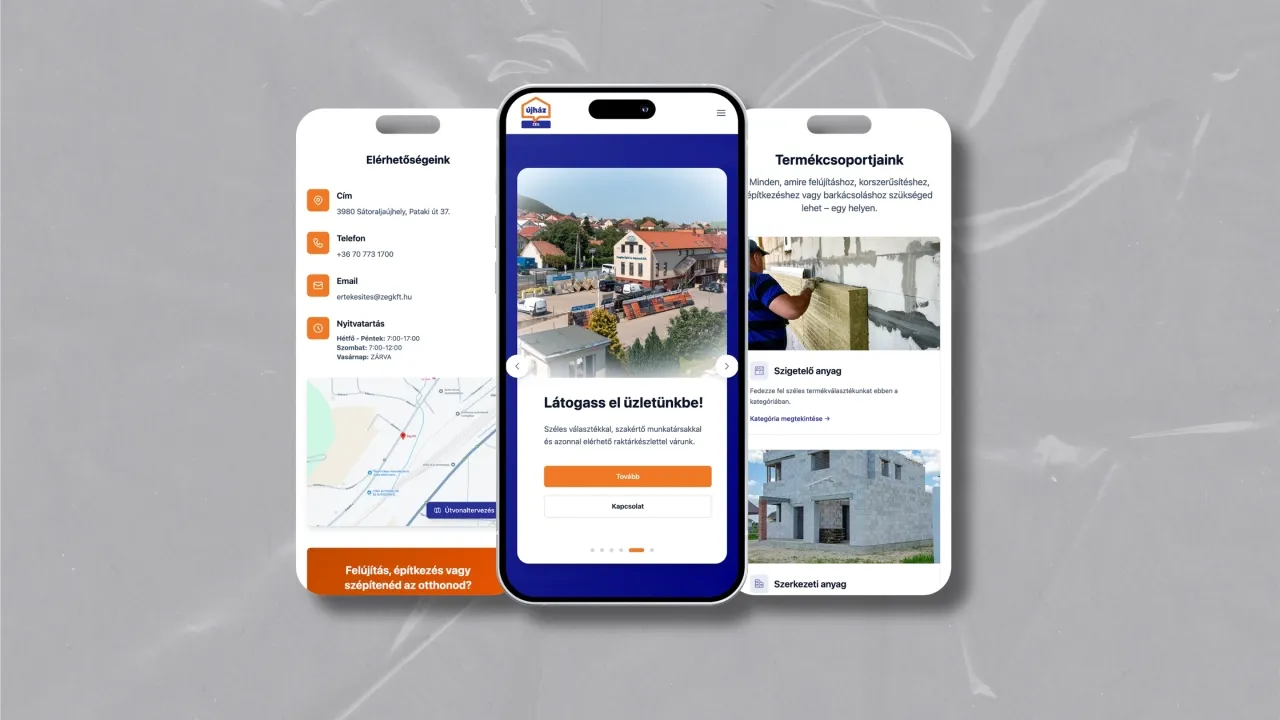
Project: Responsive website for building materials supplier Zempléni Építő és Gépészeti Kft. (ZÉG), featuring mobile-optimized navigation, clearly organized product categories and easily accessible contact information. Discover the project!
Business websites for service providers and lead generation
Trust is a decisive factor in Budapest’s service sector, whether the business is a law firm, private medical or dental practice, general construction contractor, financial consultancy or beauty salon.
A professional business website should do more than simply list the company’s services. It should present successful past projects, detailed case studies, authentic customer testimonials and industry expertise in a visually engaging way, supported by relevant facts and concrete evidence.
Carefully planning the user journey is particularly important for these websites. Visitors should always understand what action they can take next, whether that means requesting a quote, making a phone call or booking an appointment.
We support these actions through strategically positioned enquiry forms, prominent call-to-action (CTA) buttons, clickable telephone numbers and, where appropriate, automated appointment booking systems. The objective is to convert as many relevant website visitors as possible into qualified leads with genuine business value.
Online stores and complex e-commerce systems
Businesses selling physical or digital products, or offering subscription-based services, need websites that address the specific requirements of e-commerce.
Hungarian consumers, particularly those in Budapest, are increasingly accustomed to the speed, security, transparency and convenience offered by major international online retailers such as Amazon, eMAG and Alza. Our task is to translate these important aspects of the customer experience into suitable solutions for Hungarian small and medium-sized businesses, helping them reach a wider customer base.
One of the most sensitive stages of any online shopping experience is the cart and checkout process. Cart abandonment is a common challenge in e-commerce. Unexpected costs, complicated checkout procedures, slow performance and a lack of trust can all contribute to customers leaving without completing their purchases.
For this reason, we pay particular attention to integrating appropriate payment solutions, such as Barion, SimplePay, Stripe and PayPal, alongside Hungarian logistics and delivery services, including GLS, FOXPOST, Packeta and MPL. We can also integrate invoicing platforms such as Billingo and Számlázz.hu.
Depending on the capabilities of the chosen system and the project’s requirements, these connections can also be implemented through API integrations.
The result can be a reliable, automated e-commerce system capable of accepting orders around the clock while reducing manual administration and supporting the company’s sales processes.
Custom web applications, B2B portals and private systems
Growing businesses in Budapest, including logistics companies, manufacturing facilities and wholesale distributors, sometimes reach a point where conventional off-the-shelf systems can no longer adequately support their internal operations.
In these situations, custom web development and targeted system integrations may provide a more suitable solution.
A B2B ordering portal managing tens of thousands of products with individual partner discounts, an internal communication and training platform for a franchise network, or a complex engineering quotation calculator may require specialized functionality that is best delivered through a custom-built web application.
We tailor these systems to the company’s specific workflows and, where necessary, connect them to existing enterprise resource planning (ERP) or customer relationship management (CRM) systems. These integrations may involve suitable solutions from platforms such as Salesforce, MiniCRM or SAP.
Website development technologies: which platform should you choose?
The technology industry, including web development, is constantly evolving. The technology decisions made at the beginning of a project, commonly referred to as choosing the right tech stack, can have a long-term impact on website speed, security, maintenance costs, scalability and search engine optimization opportunities.
Let’s examine some of the solutions most commonly considered by businesses in Budapest.
WordPress website development: advantages and disadvantages
WordPress has been a major player in the website development market for many years. Numerous visual page builders are available for the platform, including Elementor, Divi and WPBakery. WordPress continues to power a significant proportion of websites worldwide.
Why is WordPress so popular?
WordPress has a relatively low barrier to entry, a large community of developers and users, and an extensive ecosystem of ready-made plugins. These plugins make it possible to add a wide range of features relatively quickly and cost-effectively.
For a newly established microbusiness, a straightforward company website or a blog, WordPress can still be a sensible and economical choice.
What limitations should you consider?
For more complex business requirements, some WordPress implementations may encounter limitations, particularly those relying heavily on plugins and visual page builders.
Poorly optimized page builders can generate unnecessary scripts, stylesheets and HTML elements, increasing page weight and slowing down loading times. An excessively complex Document Object Model (DOM) structure can also negatively affect performance.
Third-party plugins require regular updates and maintenance. Outdated or poorly maintained plugins may introduce security vulnerabilities, while compatibility issues can cause functionality problems.
However, these challenges do not affect every WordPress website. With proper development, optimization and maintenance, WordPress can also support fast, secure and reliable business websites.
Custom website development and modern CMS platforms: future-ready solutions
At Marketing Puzzle, we select modern web development technologies according to each project’s business objectives and technical requirements.
For Budapest-based clients with more complex needs, we increasingly recommend React and Next.js frontend development as an alternative to conventional WordPress implementations.
We also use Tailwind CSS to build visual interfaces, while content management can be handled through API-driven solutions such as Payload CMS or other headless content management systems.
What advantages can this technological approach offer?
1. Fast loading times and strong Core Web Vitals performance
Next.js supports several rendering strategies, including server-side rendering (SSR), static site generation (SSG) and various performance optimization techniques.
When implemented correctly, these capabilities can contribute to faster loading times and improved Core Web Vitals metrics. However, strong performance is not an automatic consequence of choosing a particular framework. Actual results also depend on development quality, website content, hosting infrastructure and the optimization methods used.
2. A more flexible and controllable architecture
A modern headless architecture allows the responsibilities of the public-facing website and the content management system to be separated.
Properly configured access controls, secure API communication and avoiding unnecessary dependencies can help reduce the potential attack surface.
However, Next.js and Payload CMS still require regular security updates, appropriate configuration and ongoing maintenance. No technology provides complete protection on its own.
3. Structured and straightforward content management
One advantage of headless CMS platforms over traditional visual page builders is that content management can be organized around clearly defined data fields.
For example, an editor can enter an article’s title, featured image, main content and SEO metadata in separate fields.
This can make content management more consistent and reduce the risk of accidentally changing carefully designed page layouts during routine editing.
Technology decisions should always reflect the available budget, business objectives and expected maintenance requirements.
A well-planned, modern website may offer lower long-term maintenance costs and greater scalability, particularly when compared with an overly complex system that is difficult to maintain. Nevertheless, the actual return on investment should always be assessed according to the specific circumstances of the project.
Professional web design and user experience (UX/UI)
Professional web design involves much more than creating an aesthetically pleasing website or choosing a visual style that appeals to the business owner.
Thoughtful user interface (UI) and user experience (UX) design incorporates psychological, ergonomic and marketing communication principles. Its purpose is to guide attention, make information easier to process and support users in making decisions.
Consistent use of colour, appropriate contrast, typography—including font sizes, line spacing and readability—and the effective use of whitespace all contribute to making content easier to understand with minimal cognitive effort.
A well-designed interface helps visitors navigate the website, simplifies purchasing or enquiry decisions and supports the company’s commercial objectives.
Custom design aligned with the company’s visual identity also helps establish a consistent, recognizable and credible brand presence.
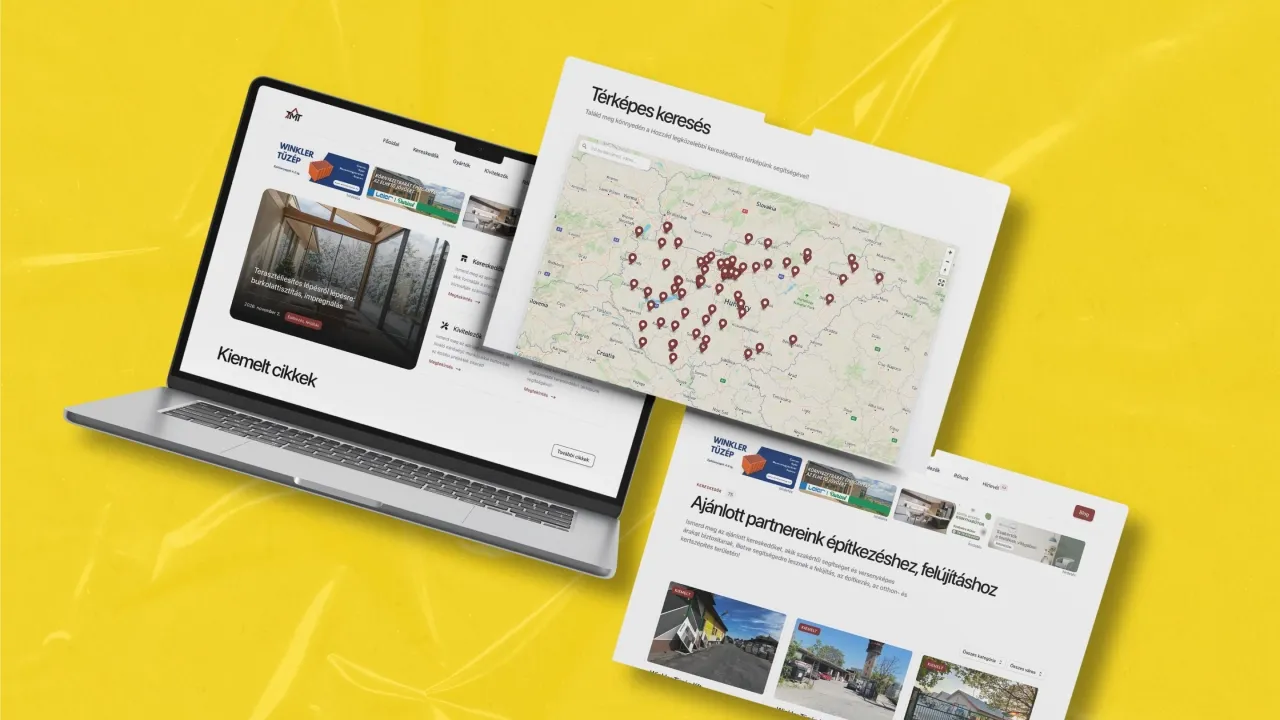
Project: Több Mint Tüzép (TMT), an online industry magazine and partner directory featuring construction and interior design articles, an interactive map-based search, advertising opportunities, and profiles of building materials retailers, manufacturers and contractors. Discover the project!
Responsive website design is now essential
A significant proportion of website traffic now comes from mobile devices, although the exact percentage varies by industry and target audience.
A mobile-friendly, fully responsive design is therefore no longer an optional extra. It is a fundamental requirement of modern web development.
If a website’s layout breaks on mobile devices, text is too small to read or buttons are difficult to tap, the user experience can deteriorate significantly, increasing the likelihood that visitors will leave.
We follow a mobile-first approach to website development, prioritizing the mobile user experience during the initial design process.
This means planning the information architecture, navigation and conversion paths with the characteristics of smaller touchscreen devices in mind.
We then adapt the interface to larger tablet and desktop displays, taking advantage of the additional space and presentation possibilities they offer.
Before launch, we test websites across different screen sizes, browsers and devices to ensure an appropriate user experience in as many relevant environments as possible.
Search engine optimization (SEO) in Budapest: how can customers find your business?
Even the most visually impressive and technically advanced website has limited business value if potential customers cannot find it.
Search engine optimization (SEO) is an ongoing, data-driven process that combines technical and content-related improvements to increase a website’s visibility and traffic from organic, or unpaid, search results.
Search competition is particularly intense in many Budapest industries, making it important to coordinate technical SEO, content optimization and local search strategies.
Local SEO: improving visibility in Budapest searches
For local service providers, including construction companies, air conditioning installers, locksmiths, law firms, beauty salons and restaurants, Google’s local search results and Map Pack can be particularly valuable.
When someone searches for phrases such as “electrician Budapest District 3” or “car repair near me”, several factors influence which businesses appear in local search results. These include relevance, distance and prominence.
An important foundation of local SEO is a properly completed and regularly maintained Google Business Profile, formerly known as Google My Business.
As part of this process, we pay attention to the consistent presentation of business information, including name, address and phone number (NAP), appropriate service categorization and the ethical collection of authentic customer reviews.
Genuine customer feedback can help prospective customers make informed decisions and may also contribute to local search visibility.
A website should also communicate its genuine local relevance. This can be supported through case studies featuring Budapest projects, authentic client references, accurate descriptions of service areas and, where appropriate, location and map information.
The objective is not to repeat district names artificially but to create credible, locally relevant content that genuinely helps people searching for services in the area.
Technical and content SEO: the foundations of search visibility
Technical SEO is not simply a plugin that can be installed after development. It should be an integral part of the website development process.
Technical optimization includes improving page loading speed, working towards strong Core Web Vitals scores, creating a clean and logical URL structure, optimizing images using modern formats such as WebP, avoiding unnecessary redirects and implementing appropriate structured data using Schema.org markup.
Structured data allows search engines to receive machine-readable information about a business, its products, prices, opening hours and certain types of reviews, for example.
Alongside a solid technical foundation, high-quality, professionally informed content is equally important.
In our copywriting and content development work, we avoid outdated practices such as unnatural keyword stuffing.
Instead, we create informative industry articles, category pages and service descriptions that provide credible, detailed answers to the target audience’s actual questions and search intent.
We also consider Google’s E-E-A-T principles when developing content. These encompass Experience, Expertise, Authoritativeness and Trustworthiness.
E-E-A-T is not a standalone ranking score. Rather, it is a framework of considerations associated with evaluating content quality and reliability.
AI SEO and generative engine optimization (GEO): preparing for AI-powered search
Search engines and online information discovery are undergoing significant changes.
Alongside traditional search results, AI-generated answers are playing an increasingly important role. Examples include Google AI Overviews and AI Mode, Perplexity, ChatGPT’s search capabilities and other AI-powered information discovery systems.
When responding to user queries, these systems may process information from different sources and consider not only keywords but also the meaning, relationships, factual accuracy and context of the content.
How can a Budapest business improve its visibility in these systems?
Approaches aimed at improving visibility in AI-powered search are often referred to as AI SEO or generative engine optimization (GEO).
The objective is to make website content accessible, understandable and trustworthy for people, search engines and AI-powered systems alike.
We support this through clear definitions, well-structured content, a logical heading hierarchy (H1, H2 and H3), direct answers to important questions and transparent, fact-based information.
Appropriately implemented structured data, credible author and company information, genuine project references and technically accessible website content may also help AI-powered systems process information more effectively.
Server-side rendering can be particularly useful for crawlers that do not execute JavaScript or have limited JavaScript rendering capabilities.
However, no technical or content optimization method can guarantee that a business will appear or be cited in AI-generated answers.
The goal is to develop credible, professionally informed and well-structured content that may increase the likelihood of a business being recognized as a relevant information source across both traditional and AI-powered search environments.
Our website development process: from planning to launch, step by step
The success of a complex web development and digital marketing project depends heavily on transparent, honest and continuous communication between the client and the development agency.
When working with Budapest businesses, we aim to maintain a clearly structured, properly documented and transparent process that clients can easily follow.
1. Free strategic consultation and requirements assessment
We begin every project by exploring the company’s business objectives, industry characteristics, target audience and relevant competitors.
Depending on the client’s needs and availability, the initial consultation can take place in person in Budapest or through an online video call. This flexibility also makes collaboration easier for business owners with demanding schedules.
2. Concept development, wireframes and a detailed quotation
Based on the strategic consultation, we outline the proposed information architecture, navigation structure and logical organization of the website.
Depending on the project’s requirements, we may also create wireframes to help define page layouts and important user journeys.
We then prepare a detailed, itemized and transparent quotation.
This allows clients to understand which tasks and costs are associated with UX/UI design, development, copywriting and fundamental search engine optimization.
We agree on the project scope, any separately priced services and the conditions for revisions in advance.
3. UX/UI design and visual planning
Before development begins, we design the website’s visual appearance in line with the company’s brand identity and business objectives.
When preparing design mockups, we consider user experience, intuitive navigation and mobile usability.
Development begins once the necessary designs and functional requirements have been discussed and approved by the client.
4. Development, coding and content integration
During frontend and backend development, we build the website’s technical foundation. Depending on the project, this may involve a modern headless architecture, custom functionality or integrations with external systems.
At the same time, we can develop professional content that takes search engine optimization and sales objectives into account.
Development takes place in a separate staging environment. Depending on the project arrangements, clients may receive access to this environment so they can follow progress and review the website before launch.
5. Testing, quality assurance (QA) and launch
Before launching a website, we carry out a thorough quality assurance (QA) process.
We check the website across different screen sizes, operating systems and browsers, including relevant mobile and desktop environments.
We test contact forms, navigation, required integrations and, for online stores, checkout and payment processes.
We also verify that HTTPS is functioning correctly, review the necessary security settings and check fundamental technical SEO requirements.
Following successful testing, we launch the website on its final domain and hosting infrastructure at a previously agreed time.
6. Personalized training and website handover
Website handover involves more than simply sending login credentials.
Through in-person or online training, we demonstrate how to manage website content using the available administration interface.
Depending on the system’s functionality, the business owner or designated employee can learn how to edit text, upload images, publish blog articles, manage products or add new portfolio projects.
Additional training materials can also be provided upon request.
Clients can also choose to have Marketing Puzzle handle ongoing website maintenance and management under previously agreed contractual terms.
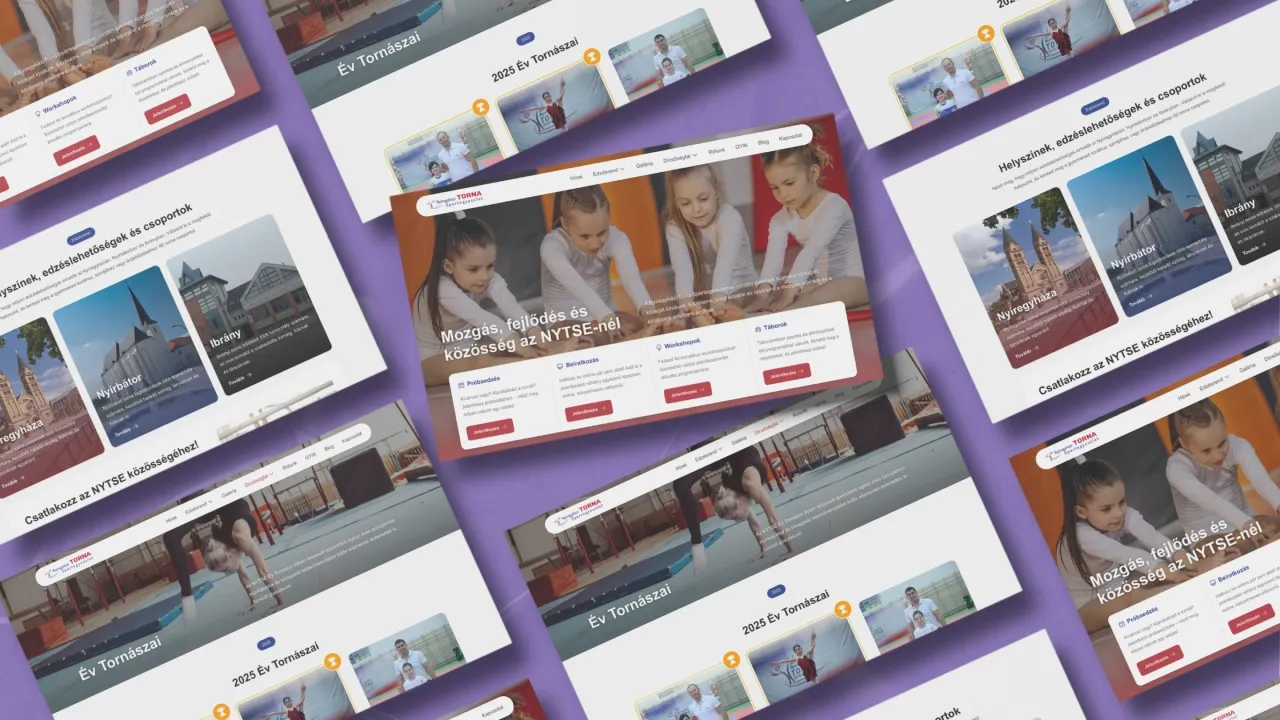
Project: A modern, responsive website showcasing the activities, training programs, locations and community content of Nyíregyházi Torna Sportegyesület (NYTSE). Discover the project!
Reliable website management: monthly maintenance and support
Launching and handing over a website does not mean the system will no longer require attention.
Even a carefully developed website built with modern technologies may need regular updates, security checks and performance optimization. This is particularly important for online stores processing transactions and complex web applications.
Hosting environments and software technologies are constantly evolving. Operating systems and frameworks receive updates, while automated attacks and malicious bots continuously search for exploitable vulnerabilities across the internet.
Neglecting a website can lead to reduced performance, functionality problems, security incidents and data protection risks.
Regular maintenance is therefore important for maintaining secure operations, appropriate loading speeds, service continuity and the technical foundations needed to support SEO performance.
Our maintenance and website management services are designed to reduce the technical responsibilities placed on our clients.
We tailor these services to the website’s technology and the client’s requirements. Depending on the agreed scope of work, our services may include the following.
Server monitoring and hosting management: Selecting, configuring and monitoring an appropriate hosting environment while considering the website’s performance and scalability requirements. Depending on the technology, this may involve conventional web hosting, high-performance SSD-based infrastructure or cloud hosting services.
Software and security updates: Controlled updates to frameworks, the content management system, required plugins and server-side runtime environments such as PHP or Node.js. These updates help reduce security and compatibility risks.
Regular backups: Setting up and verifying automated backups tailored to the project’s requirements. An appropriate backup strategy can help restore the system following technical failures, data loss or security incidents. Backup frequency, storage arrangements and recovery conditions are defined in the maintenance agreement.
Uptime monitoring: Regular automated checks to monitor website availability. Detecting potential outages can enable faster investigation and resolution of problems in accordance with the agreed response times.
Domain and HTTPS administration: Support with technical tasks related to domain names and secure HTTPS connections, including checking certificate validity and monitoring expiration dates.
For clients looking to improve their organic search rankings and strengthen their market presence over the long term, we also offer ongoing SEO and content marketing services.
These may include creating new professional articles and case studies, activities aimed at earning relevant backlinks and regularly refining technical SEO.
This allows the website to evolve beyond a static online company profile into a continuously improvable digital asset that supports measurable business objectives.
Why choose Marketing Puzzle for website development?
The website development market is crowded, but businesses still need partners who approach projects with more than technical implementation in mind.
A valuable development partner should also understand business strategy and marketing communication.
At Marketing Puzzle, we do not believe in producing identical websites on an assembly line.
We believe that an attractive website is not enough. It should also support sales, encourage enquiries and contribute to the company’s long-term business objectives.
We begin every project by understanding the client’s business model and specific requirements.
We select appropriate technologies based on the project’s goals, complexity and budget, prioritizing maintainable, secure and scalable solutions.
We aim to provide transparent communication, detailed quotations, clearly structured project workflows and support after launch.
Our goal is to deliver more than a new website. We want to help our clients build a long-term digital asset that can strengthen their competitiveness in Budapest and across Hungary.
Frequently asked questions about website development in Budapest
How long does it take to build a modern, custom business website?
Developing a well-structured business website with custom design and professionally written, SEO-optimized content typically takes 30–90 days, depending on the project’s complexity and the availability of the required materials. Systems requiring multiple custom API integrations, private B2B portals and complex online stores managing thousands of products generally take 60–180 days or potentially longer. We establish the exact timeline during the requirements assessment and project planning stages.
How much does website development cost for a business in Budapest?
Website development costs depend on the project’s complexity and specific requirements. There can be a substantial difference in the development hours and technical work required for a simple service landing page compared with a multilingual online store integrated with an enterprise resource planning (ERP) system. Following the initial free strategic consultation and requirements assessment, we prepare a personalized, detailed quotation. This outlines the agreed tasks, associated costs and conditions for any additional services, ensuring that the project’s financial scope is transparent from the outset.
Can you redesign an existing website that is slow or has an outdated design?
Yes. For these projects, we first assess the existing website’s technical condition, content and SEO performance. If the underlying system is suitable and the main requirements involve visual, UX/UI or content improvements, redesigning the existing website may be sufficient. However, if the underlying technology is outdated, presents security risks or significantly limits performance and scalability, it may be worth considering a migration to a more modern solution, such as a Next.js-based architecture. During a website redesign or rebuild, we pay particular attention to preserving previously achieved organic search rankings and traffic. This may involve establishing an appropriate URL structure, implementing necessary 301 redirects, carefully migrating content and conducting technical SEO checks. Although completely preserving previous search rankings cannot be guaranteed, a properly managed migration can significantly reduce the risk of SEO-related losses.
Can you also help us choose web hosting and manage our domain name?
Yes. As a full-service digital partner, we can also help plan and establish the technical infrastructure required for your website. We assist with choosing a suitable domain name, selecting appropriate hosting or cloud infrastructure, and configuring the necessary server and DNS settings. We ensure that secure HTTPS connections are properly configured and, if requested, can also take responsibility for additional technical tasks related to domains, hosting and website management. Our objective is to allow clients to focus on developing their businesses rather than dealing with the technical details of running a website.